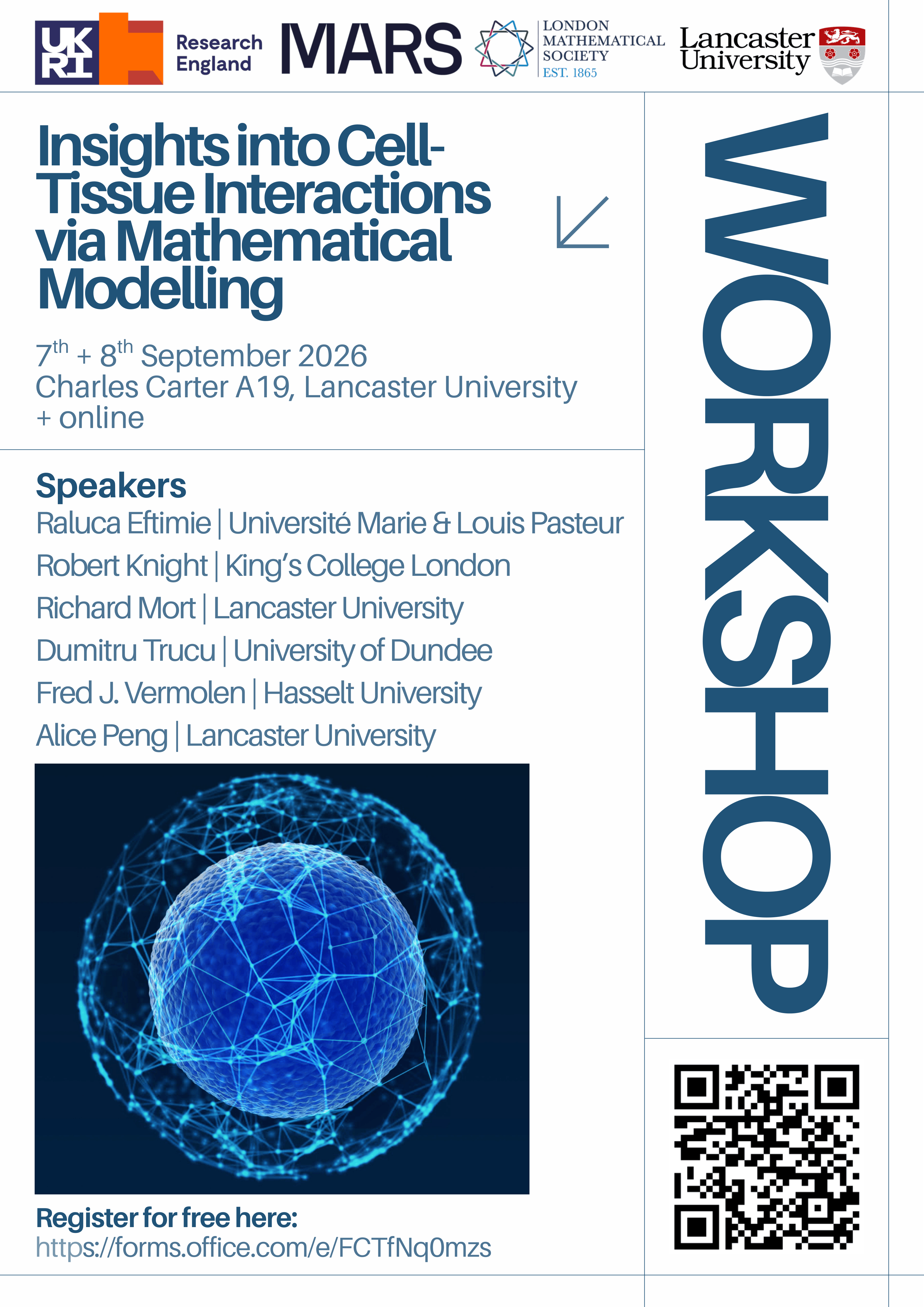
Two Half-Days Workshop: Insights into Cell-Tissue Interactions via Mathematical Modelling
This conference is to celebrate my new appointment as a Lecturer (Assistant Professor) at Lancaster University, starting in January 2025. We aim to bring together researchers in various fields who are interested in cell-tissue interactions, particularly how to use mathematical modelling to further understand the subject. Besides the plenary talks, we intentionally leave enough discussion time with the speakers, including a social dinner (participants who are interested in joining need to take care of the dinner expense themselves).The conference is jointly funded by London Mathematical Society and School of Mathematical Sciences of Lancaster University.
Key Information
- Date: 7 - 8 September, 2026
- Venue: A19 (Ground Floor), Charles Carter, Lancaster University, LA1 4YU, Lancaster, United Kingdom.
- Registration Deadline: 23 August 23:59 (BST). Free registration here.
- Format: Hybrid but regitration required.
- Speakers:
- Raluca Eftimie (Université Marie & Louis Pasteur, France)
- Robert Knight (King's College London, UK)
- Richard Mort (Lancaster University, UK)
- Dumitru Trucu (University of Dundee, UK)
- Fred J. Vermolen (Hasselt University, Belgium)
- Qiyao (Alice) Peng (Lancaster University, UK)
Summary of the Workshop
Cell-tissue interactions, including both chemical and mechanical interactions, are essential and crucially important for various biological processes, such as functioning organs, regenerating tissues and regulating cellular behaviours. In the past years, mathematical modelling has shown its great potential to further understand the biology and then predict the behaviours of cells and tissue, which is particularly beneficial to study diseases such as wound healing, cancer cell metastasis and tumour growth. Considering the difference of scales between the cell and tissue, typically multiscale and multiphysics modelling is required to describe the biological phenomenon. Furthermore, due to the irregular cell geometry, often non-local terms are involved in the model, which brings challenges when analyzing the characteristics of the model.Program (BST Time Zone)
Day 1: Monday 7 September, 2026- 14:00 - 14:20 Arrival and Registration
- 14:20 - 14:30 Welcome Talk
- 14:30 - 15:15 Raluca Eftimie
- 15:15 - 15:35 Coffee Break
- 15:35 - 16:20 Richard Mort
- 16:20 - 16:45 Coffee Break
- 16:45 - 17:30 Fred J. Vermolen
- 18:30 - 20:30 Social Dinner with Speakers (self-paid)
Day 2: Tuesday 8 September, 2026
- 09:00 - 09:30 Arrival
- 09:30 - 10:15 Robert Knight
- 10:15 - 10:35 Coffee Break
- 10:35 - 11:20 Dumitru Trucu
- 11:20 - 11:40 Coffee Break
- 11:40 - 12:25 Qiyao (Alice) Peng
- 12:25 - 12:40 Closing
Abstracts of Talks
Raluca Eftimie: Modelling fibrotic disorders: from cancers, to keloids to Dupuytren disordersFibrotic disorders encompass a broad spectrum of pathological conditions characterized by persistent fibroblast activation, excessive extracellular matrix deposition, and progressive tissue remodeling. At one end of this spectrum, fibrosis is closely intertwined with cancer, where activated stromal fibroblasts generate a dense, mechanically-altered microenvironment that can support tumor growth, invasion and immune evasion. Other fibroproliferative programs can occur independently of malignancy, producing localized disorders such as keloids and Dupuytren’s disease. Keloids arise from an abnormal wound-healing response in which fibroblasts continue to deposit collagen beyond the boundaries of the original injury, whereas Dupuytren’s disease involves the formation and contraction of fibrotic tissue within the palmar fascia, progressively restricting finger extension.
In this talk I will review some mathematical models developed over the past few years to shed new light on these three various fibrotic disorders: cancers, keloids and Dupuytren.
Robert Knight: Dissecting cell-cell interactions regulating skeletal muscle regeneration in vivo
Muscle stem cells (muSCs) are critical for muscle repair and homeostasis. Impaired muSC function occurs in a variety of diseases, including chronic inflammatory syndromes, and ageing. Muscle weakness and locomotion are associated with such conditions, suggesting a causal association with ineffective muSC function. Interactions between muSCs and other cell types such as macrophages and fibroadipogenic precursors (FAPs) are known to dictate muSC regenerative capacity, but have proven challenging to dissect due to the complex temporal and spatial nature of their association. We are interested in identifying factors that regulate muSC function, focusing on their capacity to migrate, proliferate and differentiate into muscle fibres. Using an accelerated ageing zebrafish model caused by loss of telomerase function, we have found that an impaired inflammatory response is refractory to muscle regeneration. Live cell imaging reveals MMP9 over-expression correlates with ineffective muSC responses and aberrant macrophage behaviour which we find are causative for delayed and ineffective repair process. Our analyses of cell behaviour and gene expression suggest that complex interactions between inflammatory cells, FAPS, muSCs and the extracellular matrix dictate functional muSC capacity. Framing this interaction through modelling of cell behaviour and molecular function form the basis of our future work with a goal of creating an explainable model for testing potential causal drivers of muSC function during regeneration.
Richard Mort: Live imaging and mathematical modelling of pattern formation in the developing skin
Pigmentation patterns are generated through the interaction of pigment-producing cells called melanocytes and skin cells called keratinocytes found in the epidermis and in hair follicles. Keratinocytes signal to melanocytes to instruct them in the type and amount of pigment to produce. Melanocytes colonise the skin during embryonic development, migrating and proliferating as melanoblasts before differentiating and taking up residence in the hair follicle. Regions that are not colonised appear white in the adult, providing a major mechanism of pattern generation. This colonisation of the skin by melanoblasts happens in a wave of proliferation and migration starting at the spine and extending to the belly, independently on both sides of the embryo. At the same time, follicles form through a separate patterning process that breaks the symmetry of the early embryonic skin. Only once a follicle has formed can it go on to be colonised by melanoblasts already present in the surrounding skin. We follow both of these processes directly using live imaging of cultured embryonic skin, combined with genetically encoded biosensors allowing us to monitor cell shape and migration as well as cell cycle status. Image analysis of these movies lets us extract quantitative measurements of cell movement, division timing and tissue organisation, which we then use to parameterise mathematical models. This allows us to test whether the behaviours we observe, including how cells move and how often they divide, are enough to explain the resulting patterns.
Dumitru Trucu: 3D Multiscale Moving Boundary Modelling for Malignant Solid Tumours with Focus on Glioblastoma Progression and Relapse
The genuinely multiscale nature of malignant solid tumours dynamics and the challenges that these bring are illustrated in full flavour by the case of Glioblastoma (GBM) progression and relapse in the brain. Besides recent progress, the understanding of the key mechanisms for GBM invasion remains one of the greatest challenges. The complex dynamics found there brings together cell-scale and tissue scale processes that contribute to an entire range of key aspects in tumour development and spread, notably being not only proliferation, degradation of the surrounding brain environment (via proteolytic enzymatic activity), calcium mediated adhesive processes, interactions with fibrous extracellular matrix environment, but also metabolic plasticity and ability to generate therapy-resistant subpopulations under hypoxic and treatment-induced cellular stress.
In this talk, we attempt to address these aspects by proposing appropriately tailored multiscale moving boundary modelling approaches. Moreover, aiming to address a higher level of complexity in describing the interlinked processes involved within GBM progression and relapse, we recently introduce three key extensions to the multiscale framework that was introduced and established in Trucu et al. 2013 and further developed in several scientific publications authored by the same group (notably in this and this). These extensions are structured on three avenues and include: (1) influence of the interfacial ECM fibres of tumour boundary movement; (2) non-local collective cell motility (“go-or-grow” behaviour); and (3) transitions from isotropic to anisotropic GBM invasion patterns. With this updated multiscale moving boundary modelling framework, we proceed to investigate further aspects in GBM dynamics, including the emergence of cellular stress and stress-induced resistance mechanisms driven by hypoxia and treatment, as well as the role of metabolic factors in relapse.
Fred J. Vermolen: The Application of Neural Operators to Predict Skin Evolution After Burn Trauma
Severe burn injuries leave patients with large skin trauma, in the form of hypertrophic scars and/or contractures. In order to improve treatment, understand the underlying biological mechanisms occurring during skin repair is crucially important. Since understanding aims at optimizing and improvement, quantification of the biological hypotheses is paramount and therefore mathematical models are constructed. These models are based on physics principles such as conservation of mass and momentum, and hence one is faced with solving coupled systems of partial differential equations and/or stochastic processes. Since approximating the solutions of partial differential equations by the use of finite element discretization, time integration and fixed point methods is an expensive operation, one looks for faster alternatives such as data-driven methods. In this talk, we will see how neural operators can alleviate the computational burden such that mathematical modelling results become available in clinical practice.
Practical Information
Go to the VenueThe easiest way to arrive in Lancaster is by train. After arriving at the train station, you can walk to the bus stop Common Garden Street (Stop A) (~6-minute walking), then take Bus 1/1A/2/2X/42/100 to University Underpass. Or you can take Bus 4/X4 directly from Lancaster Train station but it is less frequent comparing to the previous option. Bus ticket can be bought with card or cash from the driver. The bus journey takes around 15 - 20 minutes between the city centre and the university. After arriving at the Underpass and climbing up the square, you can walk south to Charles Carter.
Accommodation
On campus we have Guests Room which can be booked via Booking.com, or Lancaster House Hotel . In the downtown, there are also many options for accommodation.
Sightseeing in Lancaster Neighborhood
- Lancaster Castle: Lancaster Castle is one of Lancashire's key historic landmarks. A medieval castle, built on a Roman site, it was used as a court and prison for hundreds of years. Lancaster Castle is owned by the serving monarch, HM King Charles III, through the Duchy of Lancaster and hosts regular events.
- Morecambe (~30 minutes by bus): Morecambe is a seaside town and civil parish in the City of Lancaster district. Come and explore an amazing district of arts, heritage and nature. Beautiful countryside and a spectacular coastline sit alongside an inspiring city which embraces its history and welcomes the future…
- Lake District (~20 minutes by train to Oxenholme Lake District, or ~1 hour by Bus 555): Lake District is famously associated with the work of poet William Wordsworth and author Beatrix Potter. It is a UNESCO world heritage site and England's oldest and largest national park. Besides hiking and mountain biking, there are many to explore in the towns of Ambleside, Bowness and Keswick.
Acknowledgement
- This workshop was made possible through the generous funding received from London Mathematical Society and School of Mathematical Sciences of Lancaster University.
- I would also like to acknowledge the day-to-day research support from MARS: Mathematics for AI in Real-world Systems.
- Finally, the poster is designed and made by my very kind colleague Rachel Campbell.